

Summary: Growth is often viewed as a sign of success, but as Sponsoring Institutions expand, the very systems that once worked well may begin to show strain. This Insight introduces a GME Institutional Maturity Model that helps leaders recognize how organizational needs evolve as institutions grow. Learn how to identify signs of structural strain, understand the developmental stages of institutional growth, and explore practical reflection questions that support sustainable GME leadership.
Growth is often viewed as a sign of institutional success.
A new residency program launches.
Additional fellows are recruited.
Clinical partnerships expand.
Educational opportunities increase.
For Sponsoring Institutions, growth can be energizing. It signals mission alignment, organizational confidence, and a broader commitment to workforce development.
But growth also creates a leadership paradox.
The very success institutions pursue can expose weaknesses in systems that previously worked well.
This does not necessarily mean the institution is failing. It may mean the institution is developing.
The challenge is not growth itself. The challenge is ensuring organizational structure grows with it.
From an organizational psychology perspective, growth changes the system. As Sponsoring Institutions mature, they move through predictable developmental stages. Each stage requires different approaches to oversight, communication, decision-making, faculty support, coordinator infrastructure, and executive leadership engagement.
The challenge is not growth itself.
The challenge occurs when organizational structure, leadership capacity, communication pathways, and oversight systems do not evolve at the same pace as GME expansion.
Growth Changes the Institution
At a smaller scale, many Sponsoring Institutions operate effectively through relationships, informal communication, and direct access to leaders.
The DIO knows the program directors personally.
The coordinator knows who to call.
The GMEC agenda is manageable.
Problems are often solved through proximity, trust, and institutional memory.
That can work well — until growth changes the operating environment.
As programs are added, residents increase, participating sites expand requiring complex Program Letter of Agreement (PLA) management, and committees multiply, complexity grows exponentially. A Sponsoring Institution with 12 programs is not simply four times larger than one with three programs, it’s closer to sixteen times more complicated or more!
There are more stakeholders, more handoffs, more policies to operationalize (such as clinical and educational work hours), more data to monitor for the Annual Institutional Review (AIR), more faculty to develop, more residents to support, and more opportunities for misalignment.
What once felt efficient can become fragile—especially during critical transition periods. In fact, how an institution handles the first 90 days of a new academic year often reveals whether its informal, relationship-based systems are scaling effectively or beginning to break under the weight of new stakeholders.
Structural Strain Is Often a Growth Signal
When GME growth outpaces institutional structure, the signs are usually practical before they are strategic.
Leaders may notice:
- Recurring communication breakdowns
- Delayed decisions
- Committee overload
- Coordinator burnout
- Duplicated effort
- Role confusion
- Inconsistent escalation pathways
- Program directors receiving mixed messages
- GMEC agendas becoming reactive rather than strategic
- Data being collected but not meaningfully used
- Executive leaders hearing about problems late
These issues are often interpreted as performance problems – and sometimes they are – but in many cases they are developmental signals. The institution has outgrown structures that were once effective.
Growth occurs first; infrastructure catches up later. During that gap, people often compensate through extra effort, longer hours, informal workarounds, and personal relationships.
That may preserve effectiveness for a season, but it usually reduces efficiency and increases risk.
Sustainable growth requires more than committed people. It requires systems that allow committed people to function well.
Building these systems means actively investing in professional development across the institution, ensuring that program directors, coordinators, and faculty are equipped with the skills to manage increasing complexity without burning out.
Developmental Stages of GME Sponsoring Institutions
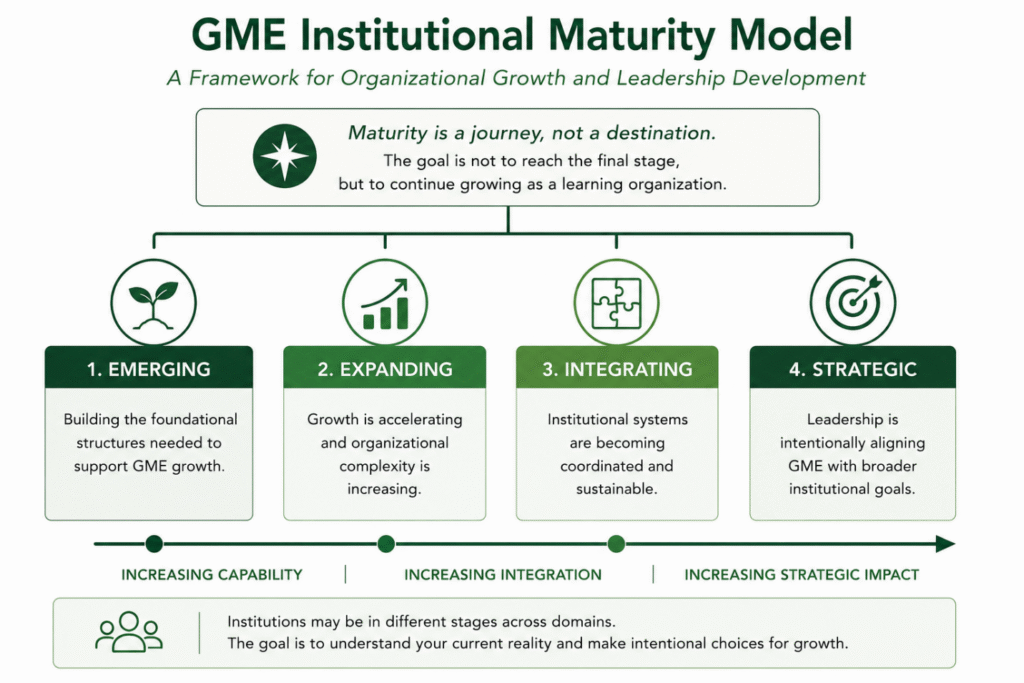
This model provides a practical way to recognize how leadership priorities evolve as Sponsoring Institutions mature.
Sponsoring Institutions do not all need the same structures at the same time. A developing SI has different leadership needs than a large, mature, multi-program institution.
A useful way to think about SI development is through four stages:
Emerging – Expanding – Integrating – Strategic
Each stage requires a different leadership posture.
- Emerging institutions need clarity.
- Expanding institutions need structure.
- Integrating institutions need alignment.
- Strategic institutions need disciplined use of data and executive-level intentionality.
Effectiveness and Efficiency Must Grow Together
In GME, leaders often focus first on effectiveness.
- Are we meeting ACGME Institutional and Program Requirements?
- Are residents appropriately supervised within the clinical learning environment?
- Are programs supported?
- Are citations and Areas for Improvement (AFIs) addressed?
- Are policies in place?
These questions matter.
But as Sponsoring Institutions grow, efficiency becomes equally important. Not efficiency as speed for its own sake, but efficiency as the disciplined use of leadership attention, committee time, coordinator capacity, faculty energy, and institutional resources.
An effective but inefficient GME system may still function, but only by over-relying on key individuals.
That creates vulnerability.
- If every issue requires the DIO’s personal intervention, the system is not scalable.
- If coordinators must remember every workaround, the system is not sustainable.
- If GMEC reviews data without clear follow-up, oversight becomes performative.
- If executive leaders only engage during crises, institutional learning is delayed.
Sustainable GME growth requires both effectiveness and efficiency: doing the right work, through the right structures, at the right level of the organization. Shifting from merely recognizing institutional maturity to intentionally strengthening your organizational structure often requires dedicated Strategic Planning Services.
A Leadership Checkpoint for Growing Sponsoring Institutions
For DIOs, GME executives, and institutional leaders, the most useful question may not be, “Are we growing?”
The better question is:
Are our structures growing with us?
Use the following checklist as a quick reflection tool.
Indicators of GME Growth
- New residency or fellowship programs have been added.
- Resident or fellow complement has increased.
- Participating sites have expanded.
- More faculty are involved in teaching and supervision.
- GMEC responsibilities have increased, requiring more robust subcommittee structures.
- Coordinator workload has expanded.
- The institution is managing more ACGME data, WebADS updates, surveys, citations, or action plans.
- Executive leadership is relying more heavily on GME for workforce strategy.
Indicators of Structural Strain
- The same issues return to GMEC without clear closure.
- Decisions are delayed because authority is unclear.
- Program directors receive inconsistent guidance.
- Coordinators are managing complexity through memory rather than systems.
- Communication depends too heavily on individual relationships.
- Faculty development is inconsistent across programs.
- Data from ACGME surveys and the AIR are collected but not integrated into leadership decisions.
- Committees feel busy but not strategic, often reacting to issues rather than proactively initiating Special Reviews.
- The DIO is pulled into operational details that should be managed elsewhere.
- Executive leaders hear about GME risks late rather than early.
If several items are noted, the issue may not be motivation, effort, or commitment.
It may be structural strain.
Take the next step: Download the GME Institutional Maturity Model to assess where your Sponsoring Institution is today and identify opportunities to strengthen the structures needed for sustainable growth.
The Executive Leadership Question
For CEOs, COOs, CMOs, DGMEs, and other executive sponsors, GME growth should prompt a broader organizational question:
What does this Sponsoring Institution need to become in order to sustain the GME system we are building?
That question shifts the conversation from endurance to design.
It moves leaders away from asking people to “just keep up” and toward building the infrastructure needed for long-term success.
Strong Sponsoring Institutions periodically ask:
- What worked when we were smaller that no longer works today?
- Where are we relying too heavily on informal communication?
- Which decisions need clearer ownership?
- What support do coordinators need before burnout becomes turnover?
- Is GMEC functioning as a strategic oversight body or only a reporting meeting?
- What data should rise to executive leadership?
- What structure do we need for the institution we are becoming?
Sustainable Growth Is Intentional Growth
Growth is not the problem.
Unexamined growth is the problem.
A Sponsoring Institution can add programs, increase complement, expand partnerships, and strengthen its educational mission while also creating operational strain. That strain does not mean the institution is weak. It may mean the institution has reached its next developmental threshold.
The leadership task is to recognize the threshold and respond intentionally.
Because in GME, sustainable growth is not measured only by the number of programs added.
It is measured by whether the institution has the structure, leadership capacity, oversight discipline, and cultural alignment to support the programs it has created. Growth may signal success. But sustainable growth signals maturity.
Continue the Conversation
Growth eventually requires new structures, not simply more effort. Depending on where your Sponsoring Institution is feeling the most strain, choose your next step:
- If you need to align your current staff and manage increasing complexity: Read Professional Development Across the Institution because institutional maturity requires intentional development across all GME roles.
- If you realize your institution needs a structural redesign, not just a quick fix: Explore Strategic Planning Services because sustainable growth requires designing the oversight and infrastructure your new programs demand.
- If you are entering a new academic cycle or anticipating leadership transitions: Review The First 90 Days: How New Academic Years Shape Organizational Culture because sustainable growth is built.
Or explore our full library of expert-driven content, tools, and frameworks designed specifically to help GME organizations build resilient structures, align leadership, and maintain ACGME compliance: Access the Partners® GME Resources Library.